“Magic in Britain: A History of Medieval and Earlier Practices” by Robin Melrose

"Magic, both benevolent (white) and malign (black), has been practiced in the British Isles since at least the Iron Age (800 BCE-CE 43). "Curse tablets"--metal plates inscribed with curses intended to harm specific people--date from the Roman Empire. The Anglo-Saxons who settled in England in the fifth and sixth centuries used ritual curses in documents, and wrote spells and charms. When they became Christians in the seventh century, the new "magicians" were saints, who performed miracles. When William of Normandy became king in 1066, there was a resurgence of belief in magic. The Church was able to quell the fear of magicians, but the Reformation saw its revival, with numerous witchcraft trials in the late...>>

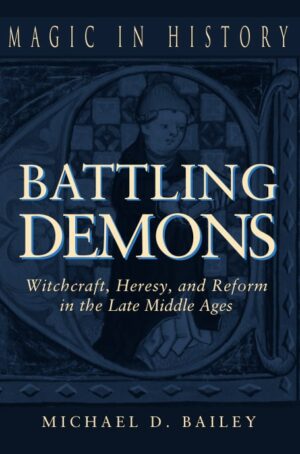
“Fearful Spirits, Reasoned Follies: The Boundaries of Superstition in Late Medieval Europe” by Michael D. Bailey

"Superstitions are commonplace in the modern world. Mostly, however, they evoke innocuous images of people reading their horoscopes or avoiding black cats. Certain religious practices might also come to mind-praying to St. Christopher or lighting candles for the dead. Benign as they might seem today, such practices were not always perceived that way. In medieval Europe superstitions were considered serious offenses, violations of essential precepts of Christian doctrine or immutable natural laws. But how and why did this come to be? In Fearful Spirits, Reasoned Follies, Michael D. Bailey explores the thorny concept of superstition as it was understood and debated in the Middle Ages. Bailey begins by tracing Christian thinking about superstition from the...>>

“Magic and the Magician: Training and Work in Ritual, Power and Purpose” by W. E. Butler

"W.E. Butler, founder of The Servants of the Light School of Occult Sciences, was an occult teacher and this compilation brings together his first two works - "Magic: Its Ritual, Power and Purpose" and "The Magician: His Training and Work". The first book explains the ancient uses, ritual and true aims of magic showing how magic is based upon profound psychological laws. The second book conveys every aspect of magical training, including visualization, vestments, Tattvic tides, talismans, the Body of Light and the way to attainment as well as explaining the core of magical philosophy, the Hebrew Qabalah or "tree of life"...>>

“Glamorous Sorcery: Magic and Literacy in the High Middle Ages” by David Rollo

"Rollo's highly specialised analysis examines the spread of literacy and the relationship between vernacular and latin literature in 12th-century Europe. He focuses on how secular and clerical writers used magic as a metaphor for writing and examines the literary devices and works of William of Malmesbury, Geoffrey of Monmouth, John of Salisbury, William Fitzstephen, Richard FitzNigel, BenĂ´it de Sainte-Maure and Gerald of Wales. Extracts include English translations."...>>

“A Philosophy of Madness: The Experience of Psychotic Thinking” by Wouter Kusters

"In this book, philosopher and linguist Wouter Kusters examines the philosophy of psychosis—and the psychosis of philosophy. By analyzing the experience of psychosis in philosophical terms, Kusters not only emancipates the experience of the psychotic from medical classification, he also emancipates the philosopher from the narrowness of textbooks and academia, allowing philosophers to engage in real-life praxis, philosophy in vivo. Philosophy and madness—Kusters's preferred, non-medicalized term—coexist, one mirroring the other. Kusters draws on his own experience of madness—two episodes of psychosis, twenty years apart—as well as other first-person narratives of psychosis. Speculating about the maddening effect of certain words and thought, he argues, and demonstrates, that the steady flow of philosophical deliberation may sweep one...>>