02.05.2022 “Talk To The Entities: Are Ghosts Real?” by Shannon O’Hara (2nd edition) Magick Matters "Welcome the first book written by Shannon O'Hara, founder and creator of Talk To The Entities®; a global company educating and empowering people in the area of entities using the amazing tools of Access Consciousness®. Come along on Shannon's amazing journey growing up, talking with and seeing ghosts, as well as all the struggles, difficulties, joy and magic along the way. If you have ever had any curiosity about this subject at all, this book is for you. If you want to learn how to open up to your own abilities with entities, this book is for you. If you want to change the way you perceive the world, and also the way we ...>> View
02.05.2022 “The Goddess of Wytches” by Zan Fraser Magick Matters "The great Goddess is a combination of the old mother-goddesses of Europe, who were not forgotten by fickle worshippers after the introduction of Christianity, but who continued to be remembered and worshipped by the women of Europe for centuries after, and who, in return, continued to participate in her followers' lives. The Goddess of Wytches reaches deep into this rich and fascinating goddess tradition, used by women as a source strength and a means to find the goddess within."...>> View
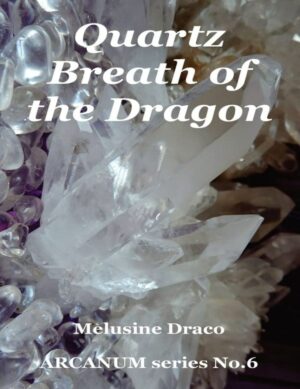
02.05.2022 “Quartz: Breath of the Dragon” by Melusine Draco (ARCANUM) Magick Matters "Since antiquity, varieties of quartz have been the most commonly used minerals in the making of jewellery and hard-stone carvings, while in the metaphysical world even the smallest piece is imbued with powerful properties that enable the bearer to cross the boundaries between the worlds. Archaeologists are now finding more and more evidence that quartz played an important part in the ritual and burial customs of our Ancestors. In truth, as Dr Meriem Clay-Egerton asserted some forty years ago, the use of quartz in prehistoric stone-working traditions was a worldwide phenomenon. For archaeologists, however, quartz was often misidentified, or ignored. Indeed, well into the 20th-century, quartz artefacts were routinely discarded during excavations. A new study ...>> View
02.05.2022 “Thrice Great Thoth: The Magician’s Magician” by Melusine Draco (ARCANUM) Magick Matters "In its simplest form, the modern function of the ancient Egyptian god, Thoth, can be seen as being the patron of writers and magical practitioners. Thoth is attested from the earliest historical periods onwards: he already played a prominent role in the oldest religious texts of Egypt, the Pyramid Texts, and continues to appear almost everywhere in Egypt up to the end of Egyptian religion some 4000 years later. Throughout this long period the god is overwhelmingly present in a vast body of documentation that yields an extraordinarily colorful picture of his nature and functions within the Egyptian pantheon. We should not forget that the archaic Thoth-cult of the pre-Dynastic era was a long ...>> View
02.05.2022 “Gateways to Otherworld” by Melusine Draco (ARCANUM) Magick Matters "When we talk of Otherworld, we are usually referring to the world of spirit, of Fae, and the ancient Ancestors, from whom kindred calls to kindred and blood calls to blood. It is a separate reality, or a world that exists simultaneously with ours, but independent of it — and most true witches find that they spend their lives with one foot in the ‘real’ world and one in Otherworld. We co-exist in a way that enables us to ‘see’ things on the other side of the veil without the rigmarole of trance- or path-working, self-hypnosis, meditation or contemplation. To find the psychic gateways or portals that enable us to step through into this ...>> View