“Mercurius: The Marriage of Heaven and Earth” by Patrick Harpur (older 1990 edition)

"Know this: I, Mercurius, have set down a full, true and infallible account of the Great Work. But I give you fair warning that unless you seek the true philosophical gold and not the gold of the vulgar; unless your heart is fixed with unbending intent on the true Stone of the Philosophers, unless you are steadfast in your quest, abiding by God's laws in all faith and humility and eschewing all vanity, conceit, falsehood, intemperance, pride, lust and faintheartedness, read no further lest I prove fatal to you. In 1952 a country clergyman called Smith begins his tortuous quest for the Holy Grail of alchemy — the Philosophers' Stone which transmutes base metal to...>>

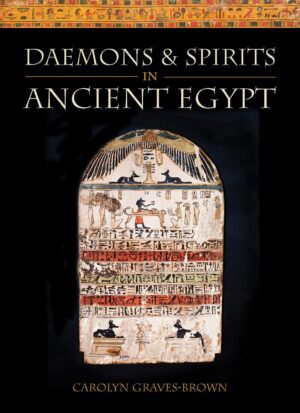
“Daemons and Spirits in Ancient Egypt” by Carolyn Graves-Brown

"This book is about the weird and wonderful lesser-known ‘spirit’ entities of ancient Egypt—daemons, the mysterious and often fantastical creatures of the Egyptian ‘Otherworld’—and the closely related spirits of the dead, which together conjure the excitement of all things otherworldly. Daemons and spirits are generally defined in Egyptology as creatures not of this world, which do not have their own cult centre, and both groups are frequently listed together in protective spells. This volume explores the general nature of daemons and spirits in ancient Egypt and discusses a selection in more detail: it uses artefacts from Wales’s important collection of Egyptian objects at the Egypt Centre at Swansea University, in which are to be...>>

“The Tree of Life and the Holy Grail: Ancient and Modern Spiritual Paths and the Mystery of Rennes-le-Château” by Sylvia Francke (revised and updated)

"Recent works of fiction and popular history have promoted the idea that the Holy Grail symbolizes a physical bloodline that resulted from a union of Jesus Christ and Mary Magdalene. It is claimed by some that this is the secret kept tirelessly by certain esoteric movements for the past two millennia. Based on her groundbreaking research, Sylvia Francke exposes this notion as a blatant misinterpretation of the mystery traditions that preceded and ran parallel to the birth of Christianity. She traces the ancient spiritual paths of knowledge from the Cathars, the Knights Templar, and the enigmatic Rosicrucians, to the work of Rudolf Steiner in the twentieth century. Here, she concludes, is true Grail knowledge―the Tree...>>

“What’s Your Big Three?: How Sun, Moon & Rising Signs Reveal Who You Really Are” by Andrea Taylor

"Uncover Deep Truths About Yourself through Sun, Moon, and Rising Signs Embark on a fascinating journey of self-discovery by exploring the three most important facets of your astrological blueprint. Your sun sign represents your will; it's who you are at your core. Your moon sign reveals your inner self, where vulnerability, emotions, and needs reside. Your rising sign, or ascendant, describes the outer layer you show to people when you first meet. This beginner-friendly book reveals the energies you were born with and how they influence your motivations, fears, and challenges. You'll also learn to identify how the big three affect your family, friends, and colleagues. With an enhanced awareness of yourself and those around...>>
“The Karma of Anthroposophy: Rudolf Steiner, the Anthroposophical Society and the Tasks of Its Members” by Rudolph Steiner

"During 1924, the last full year of Rudolf Steiner’s life, he gave a series of urgent, sometimes impassioned, talks to members of the Anthroposophical Society about their karma and its relationship to contemporary culture, referring in particular to the vital task of renewing civilization and preserving it from the threat of decline. Steiner’s words reveal a great gathering of forces to do spiritual battle for the soul of humanity. He presents a striking panorama in which anthroposophists are compelled to broaden their vision―to see true esoteric and exoteric anthroposophic work as a living yeast that can leaven all culture. To awaken members of the Anthroposophical Society to the significance of their task, Steiner could see...>>