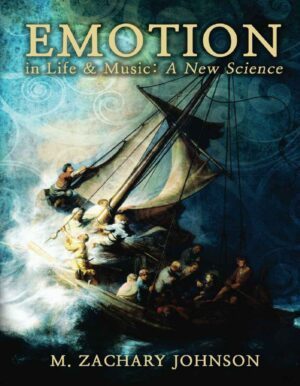
“Emotion in Life & Music: A New Science” by M. Zachary Johnson

"What does it mean for music to be emotional? How can these mysterious feelings be understood and validated? Some modern thinkers, unable to find an answer, have gone so far as to declare that music must be pure form, without emotion. Yet philosophers from Confucius to Plato and Aristotle, religious traditions from Hinduism and Buddhism to Christianity, all regarded music as a profound form of moral-emotional training. Can we link the ancient spiritual purposes of music to our modern secular and scientific understanding of man? This book argues we can, presenting a new theory that music produces the psychological signature of emotion—a motion of the mind with a distinctive set of mathematical characteristics. This theory provides a...>>

“Of Mind and Music” by Laird Addis

"In this fascinating account of the way in which we understand music, Laird Addis builds on the idea, first articulated by Susanne Langer, that passages of music symbolize emotions and other conscious states. He maintains that the unique bond joining music and feelings is based on a previously unnoticed affinity between consciousness and sound. Addis combines a scholar's insight with a musician's sensibility to make an engaging and convincing statement that will help readers comprehend music's importance in human affairs."...>>

“The Psychology of Music” edited by Diana Deutsch (3rd edition 2013)

"The Psychology of Music serves as an introduction to an interdisciplinary field in psychology, which focuses on the interpretation of music through mental function. This interpretation leads to the characterization of music through perceiving, remembering, creating, performing, and responding to music. In particular, the book provides an overview of the perception of musical tones by discussing different sound characteristics, like loudness, pitch and timbre, together with interaction between these attributes. It also discusses the effect of computer resources on the psychological study of music through computational modeling. In this way, models of pitch perception, grouping and voice separation, and harmonic analysis were developed. The book further discusses musical development in social and emotional contexts,...>>

“Handbook of Music and Emotion: Theory, Research, Applications” by Patrik N. Juslin and John Sloboda

"Music's ability to express and arouse emotions is a mystery that has fascinated both experts and laymen at least since ancient Greece. The predecessor to this book Music and Emotion (OUP, 2001) was critically and commercially successful and stimulated much further work in this area. In the years since publication of that book, empirical research in this area has blossomed, and the successor to Music and Emotion reflects the considerable activity in this area. The Handbook of Music and Emotion offers an up-to-date account of this vibrant domain. It provides comprehensive coverage of the many approaches that may be said to define the field of music and emotion, in all its breadth and depth. The first...>>

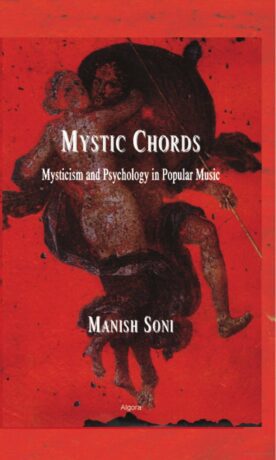
“Mystic Chords: Mysticism and Psychology in Popular Music” by Manish Soni

"Rock and roll, and archetypal symbolism? Citing baby-boomer favorites including Bob Dylan, Bob Marley, the Beatles and other Rock greats, the author shows that they have drawn on the same primal source from which mythology, dreams, and poetic insight arise. Using illustrative references to passages from the Bhagavad Gita and the Bible, Carl Jung and Sigmund Freud, Joseph Campbell and the Tao Te Ching, Manish Soni highlights some of the parallels between psychology, mysticism, religion, and contemporary art forms, as they all contribute to our human quest for greater meaning."...>>