“Mysterious Phenomena of the Human Psyche” by Leonid Leonidovich Vasiliev
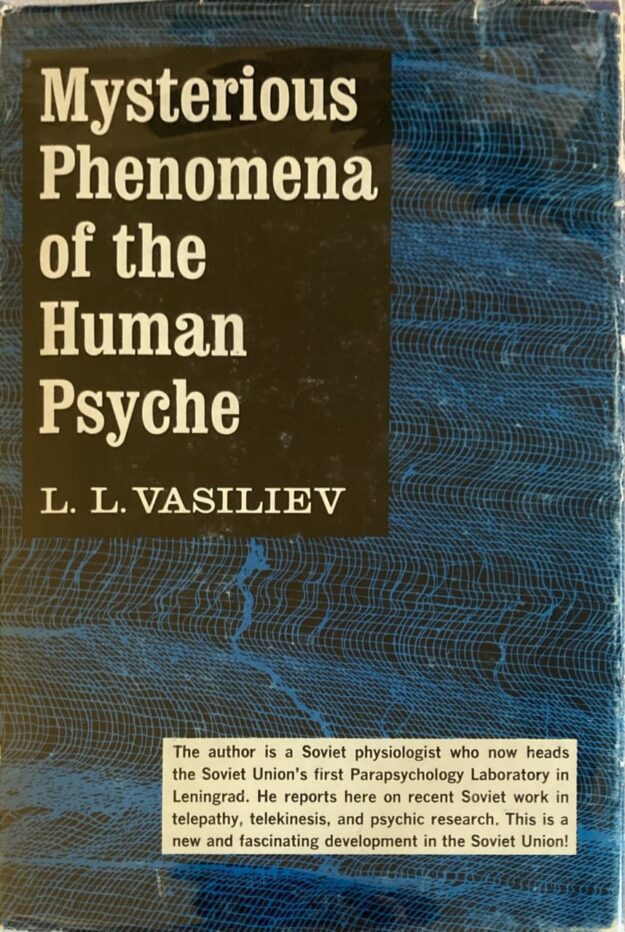
"This book, the first of its kind to be published in the Soviet Union, heralds a new and fascinating scientific development. The author is an important Soviet physiologist and a pioneer in the study of parapsychology. At his suggestion, a special parapsychology laboratory, the first of its kind in Russia, has been established at Leningrad University.
Dr. Vasiliev's book, in this first authoritative translation from the original Russian, provides us with valuable insight into a new and important line of research in the U.S.S.R.
Until very recently, the official Soviet attitude towards psychic research was the usual materialist viewpoint of hostility directed at what was considered to be the remnants of religious superstition. But now, for the first time since the Russian Revolution, things have taken a radical turn. It appears that the Soviet masters are currently sponsoring a broad program of research in hypnosis, telepathy, telekinesis (moving objects by thought), eyeless sight — all manner of strange things!
Dr. Vasiliev explores nine major areas of paranormal experience: sleep and dreams, hypnotism, suggestion and autosuggestion, automatic movements, telepathy, extrasensory perception, telekinesis, and death. He discusses the much-publicized case of Rosa Kuleshova, the woman who could read through her fingertips. He also considers at length the extraordinary case of Rudi Schneider, the medium who, under the most exacting scientific scrutiny, could move objects without making any physical movement or contact.
Vasiliev also outlines his own experiments on the effect of mescaline on clairvoyant perception. These will be of particular interest to those concerned with the work being done in the United States with the new psychedelic drugs.
During a lecture course at the university, Dr. Vasiliev reports, the question most frequently put to him was: "Does a 'mental radio' exist"? The term was first used in Upton Sinclair's experiments in America. Russian researchers are now convinced of the immediate importance of understanding the nature of "brain waves" and the means by which these waves are transmitted from one person to another when speech or mechanical means of communication are not employed."
 You need a working Telegram client app or Web Telegram account to open the links!
“Unbelievable: Investigations into Ghosts, Poltergeists, Telepathy, and Other Unseen Phenomena, from the Duke Parapsychology Laboratory” by Stacy Horn
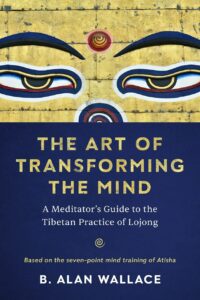
“The Art of Transforming the Mind: A Meditator’s Guide to the Tibetan Practice of Lojong” by B. Alan Wallace (2022 edition)

“Energy Strands: The Ultimate Guide to Clearing the Cords That Are Constricting Your Life” by Denise Linn

“Vitamin G : Gratitude. The Daily Supplement to Create a Magical Life of Fulfilment You Deserve” by Prashant Jain

“The Collected Fantasies of Clark Ashton Smith” edited by Scott Connors and Ron Hilger (five-volume set)

“How to Use Amulets, Charms, and Talismans in the Hoodoo and Conjure Tradition: Physical Magic for Protection, Health, Money, Love, and Long Life” by Catherine Yronwode and Gregory Lee White

“Witchcraft for Emotional Wisdom: Spells, Rituals, and Remedies for Healing” by Paige Vanderbeck

Comments and discussion can be found in the channel